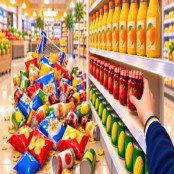
Gobble Pit is about more than collecting goodies. Each stage has timed goals. Map obstructions must be adjusted and collection spots carefully chosen.
Gobble Pit's gameplay involves moving the pit, absorbing items, and growing.
Players drag their mouse or finger to manipulate the pit. A little object falls into the pit and disappears from the map when it approaches its range. As this continues, the pit develops throughout the level.
Note that not all things can be absorbed immediately. Before swallowing larger prey, a small pit must accumulate adequately sized things.
This growing mechanic keeps the experience fresh. Once the pit expands, huge objects may become easy targets.
The pit can only absorb anything smaller than itself, which is the basic rule. This rule controls all level progression.
Some objects won't fall into a little pit. As the pit expands, greater objects can be absorbed.
Size is the main aspect of Gobble Pit's ability to absorb items. Every map object has a size restriction, and the pit can only eat smaller stuff.
Players find little, edible objects like:
The pit can consume larger things like giant present boxes as it grows.
This progression feels progressive. The map shows the pit's expansion at each step as well as its collection.
Time limits are another crucial part of Gobble Pit. Players must achieve collection goals before the countdown ends.
This makes map awareness essential to gameplay. If players move without considering their level goals, they risk squandering time in unproductive locations.
Object sizes can affect progress. Level requirements are tied to the growth mechanic since some targets can only be devoured when the pit is large enough.
Not all map items are edible. Bombs and spikes limit movement in Gobble Pit.
These elements complicate the map. Instead of just deepening the hole, players must discriminate between consumables and risks. This keeps games from becoming an automated collection procedure. Each level needs attention to the environment and map modifications.